Every bolted connection.
Every 10 seconds.
Fiber-optic probes on the connections of switchgear, circuit breakers, transformers, frequency converters and power supplies, including medium-voltage equipment, and software that finds the loose connection while it is still only warm. Continuous data for your NFPA 70B maintenance program.
The weak point is the connection, not the equipment.
From the incoming switchgear to the load, a plant's power path carries thousands of amps through hundreds of bolted and clamped connections. When one loosens, it heats with every load cycle. HotLug Watch puts a probe on each connection that matters.
Switchgear and circuit breakers
Busbar joints, breaker and disconnect contacts, cable terminations, in air- and gas-insulated switchgear.
Transformers
Bushing and terminal connections on the primary and secondary side, and the busbars or cables leaving them.
Frequency converters and drives
Rectifier and inverter connections, DC link and output terminals of medium-voltage drives and induction power supplies.
Power supplies and rectifiers
High-current DC supplies for electrolysis, plating and furnaces, with their busbars and water-cooled cables.
Capacitor banks and filters
Capacitor, reactor and contactor connections in power factor correction and harmonic filters.
Motors and cable connections
Motor terminal boxes, cable lugs and bus ducts, where the current reaches the load.
Low or medium voltage, air- or gas-insulated, indoor or outdoor. Every probe plan is drawn up from your single-line diagram and electrical drawings.
Why connections fail
- Load cycles heat and cool them every day, and bolts lose tension.
- Contact faces oxidize; a little more resistance means a lot more heat.
- After maintenance, a connection can go back together with the wrong torque.
Why yearly thermography misses it
- A connection can go from warm to burnt in weeks, between two surveys.
- Many connections sit behind covers, inside closed switchgear or are water-cooled, out of a camera's sight.
- A survey sees one load on one day; a probe sees every load cycle.
The hot connection, the reason, and what to do next.
Compared with matching connections
Probes that carry the same current should run alike. One that runs hotter stands out at any load.
Limits you already know
Rise over ambient after NETA MTS, absolute limits after NEC 110.14(C), per connection type.
Rapid rise
A probe heating faster than the others in 10 minutes is flagged at once. All rising together is the load going up.
Explained in plain words
Each finding comes with a plain-language explanation and what to check. Optional: a local AI on a more powerful PC explains each finding in its context, writes the shift report and answers your team's questions. Alarms never depend on it.
Data for your NFPA 70B program, around the clock.
Since its 2023 edition, NFPA 70B is a standard, no longer a recommended practice. It asks for a documented electrical maintenance program, equipment judged by its condition, and infrared inspection at least once a year.
HotLug Watch adds what a yearly survey cannot: the temperature of every critical connection under every load, compared and recorded. It also tells your thermographer where to look first.
A documented electrical maintenance program (EMP), with records of what was inspected and found.
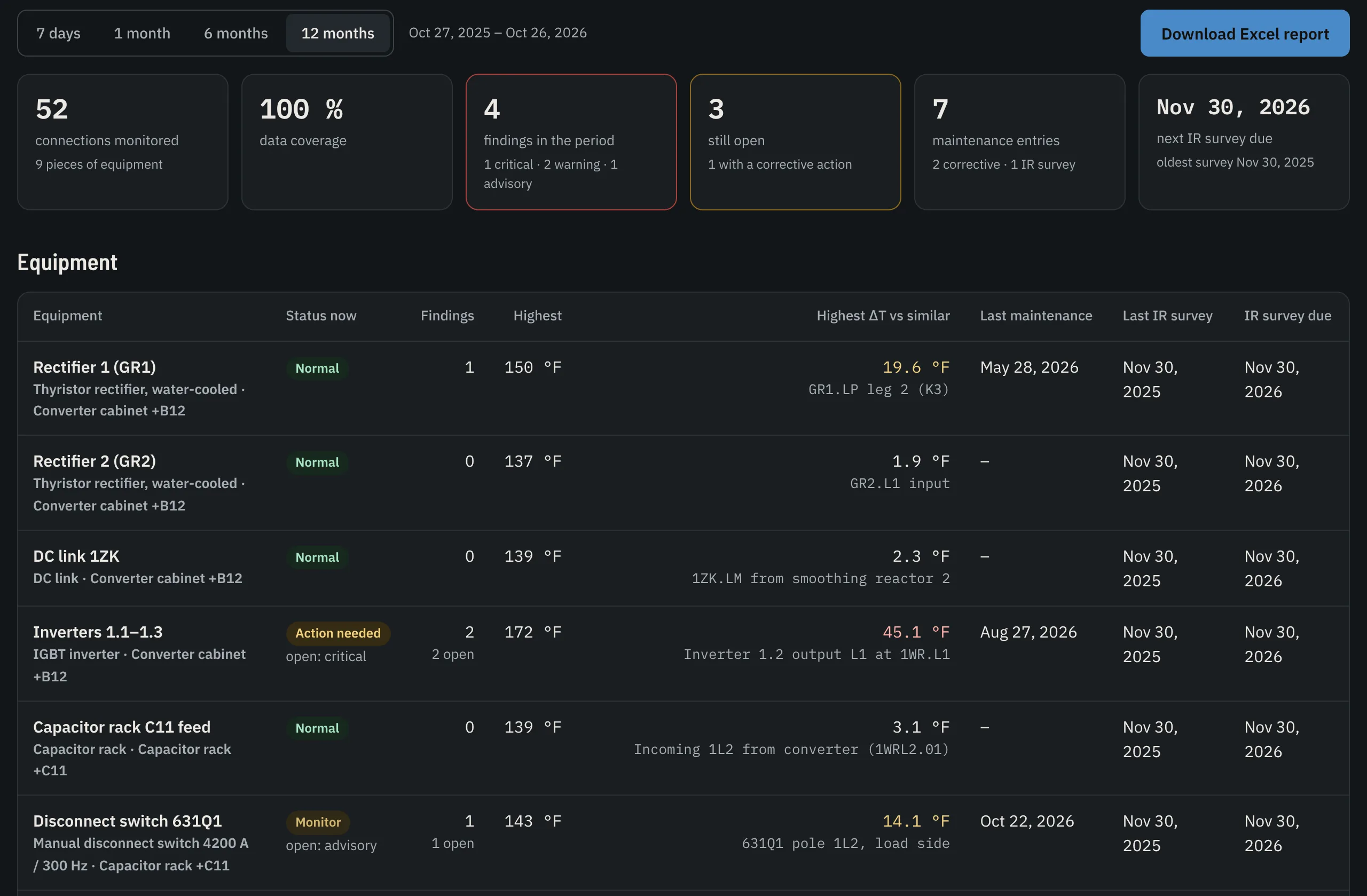
Every finding is logged with its date, the temperatures, the difference to similar connections, who acknowledged it, and the corrective action with its work order.
Infrared inspection of electrical equipment at least every 12 months, and every 6 months for equipment in poor condition.
Fiber-optic readings every 10 seconds between the surveys, including connections behind covers, inside closed switchgear and on water-cooled lugs that a camera cannot see.
Temperature differences documented against similar components and against ambient.
The same comparison runs by itself around the clock: each connection against similar connections on the same current, and against cabinet ambient.
Maintenance intervals set by the condition of the equipment, with monitoring alerts taken into account.
A clear status for every piece of equipment, with the history behind it, so your condition assessment rests on data instead of one day a year.
Proof that corrective work was done and solved the problem.
Record the maintenance, and the next load cycles show whether the connection is back in line with its group.
HotLug Watch supports your electrical maintenance program. It does not replace the program, the qualified persons who run it, or the inspections your program, your insurer or your authority having jurisdiction require. Based on NFPA 70B, Standard for Electrical Equipment Maintenance, 2023 edition. NFPA 70B is a trademark of the National Fire Protection Association; HotLug Systems is not affiliated with NFPA.
From your drawings to a running system in one planned outage.
- 01Send us your electrical drawings. We read the power path from the incoming supply to the load and mark the connections that matter most.
- 02Probe plan and fixed-price quote within two weeks. Every probe named and placed, every module and fiber run listed.
- 03Installation during your next planned outage. Two to three days per system, with your electricians, under lock-out/tag-out and NFPA 70E.
- 04Three-month pilot with a written report. Baseline, findings and recommendations for your system, in a report your team can act on.
- 05Service plan. Updates, remote support, a yearly thermal health report and a new baseline after every maintenance.
Wherever high power passes through a bolt.
Industrial plants
Steel, chemicals, mining, paper: medium-voltage switchgear, drives and transformers.
Utilities and data centers
Substations, ring main units and the power path to critical loads.
Induction melting and heating
Foundries, forging and hardening lines, from the converter to the coil.
Electrolysis and plating
Large DC rectifiers and high-current busbars.
Your data stays in your plant.
HotLug Watch needs no internet connection. It adds analysis to your equipment and never becomes part of its protection.
- Probes
- Fiber-optic, all-dielectric, 80 kV dielectric withstand, unaffected by electric and magnetic fields; standard probes to 120 °C (248 °F), high-temperature probes to 160 °C (320 °F)
- Modules
- 18 probes per module, as many modules as the system needs; Modbus TCP, 24 VDC, DIN rail; 5-year manufacturer warranty on modules and probes
- Readings
- Every 10 seconds; every reading kept 90 days, 5-minute averages 5 years
- Runs on
- One PC in your plant, opened in any browser on your network; operator, technician and admin roles; °F or °C per user
- AI
- Optional. A language model on the plant PC, for explanations, shift reports and questions. Alarms never depend on it
- Protection
- Each module's own alarm relay stays hardwired to your existing alarm or control system
Twenty years inside induction melting systems.
HotLug Systems was founded by Nicolai Zernikow. For more than 20 years he worked for a well-known manufacturer of induction melting systems: first as a field service engineer, then supervising furnace installations on site, and later managing the service organization.
That means thousands of hours in front of converter cabinets and capacitor racks, at commissioning, on breakdown calls and during planned outages. Again and again the cause was the same: a bolted connection that had loosened, heated up and failed, often weeks after the last inspection.
HotLug Watch is built from that experience. It watches the connections a service engineer knows are critical, in the language a maintenance team uses, and it is planned, installed and supported by someone who has stood in front of equipment like yours.
Let’s talk about your system.
You get a probe plan and a fixed-price quote for your system within two weeks. Drawings help, but a short description of your system is enough to start.